

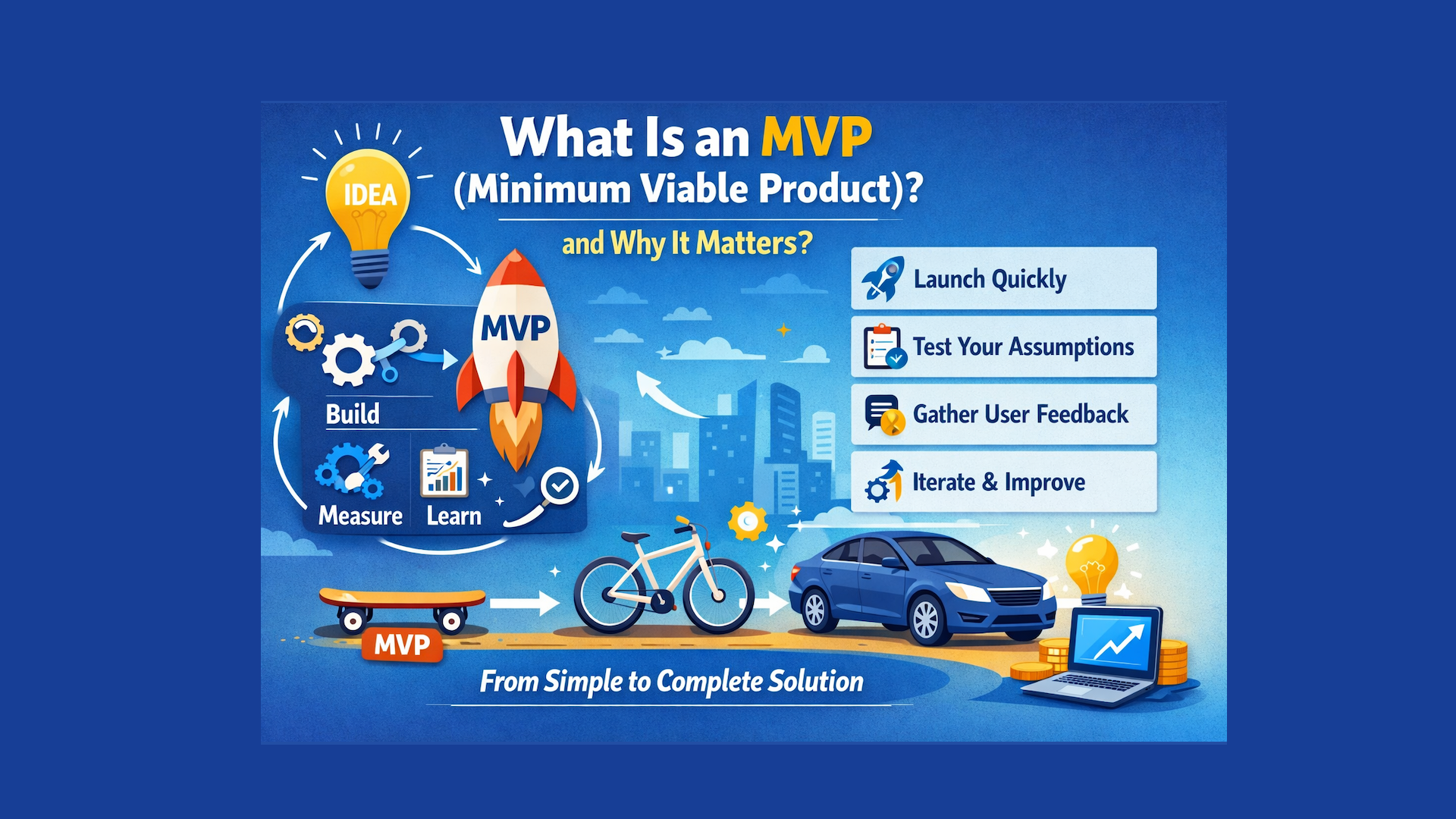
What Is an MVP (Minimum Viable Product) and Why Does It Matter?
- App Development
-

By Jaydeep
- December 22, 2025
Building a new product is exciting—but it can also be risky. Many products fail not because the idea is bad, but because teams spend too much time and money building features that users do not actually want.
This is where an MVP (Minimum Viable Product) becomes important.
In this guide, you’ll learn what an MVP is, why it matters, how it works, and how to use it the right way
What Is an MVP (Minimum Viable Product)?
A Minimum Viable Product (MVP) is the simplest working version of a product that solves one main problem for users.
It has only the most important features needed to:
- Be usable by real people
- Test if the product idea is useful
- Collect real feedback
In short:
An MVP helps you learn fast with minimum effort and cost.
Breaking Down the Term “Minimum Viable Product”
- Minimum: No extra or fancy features
- Viable: It must work and provide value
- Product: A real thing users can actually use
An MVP is not about being perfect. It is about being useful enough to learn from.
Why MVPs Are Important in Product Development
Many startups and businesses fail because they assume they know what users want. An MVP helps remove this guesswork.
Key Reasons Why an MVP Matters
1. Reduces Risk and Saves Money
Building a full product without testing demand can be very expensive. An MVP helps you:
- Avoid building unwanted features
- Reduce development costs
- Test ideas before investing heavily
2. Validates Real Market Demand
An MVP answers one critical question early:
Do people actually want this product?
Instead of opinions, you get:
- Real users
- Real usage
- Real data
3. Collects Real User Feedback
With an MVP, feedback comes from actual behavior, not assumptions.
You learn:
- What users like
- What confuses them
- What features they really need
4. Faster Time to Market
An MVP allows you to launch faster, learn faster, and improve faster.
This is especially important in competitive markets.
What an MVP Is NOT
Many people misunderstand MVPs. Let’s clear this up.
An MVP is NOT:
- A design mockup
- A clickable prototype
- A half-finished product
- A buggy or broken app
MVP vs Prototype vs Final Product
How the MVP Process Works
The MVP approach comes from Lean Startup thinking, popularized by the book The Lean Startup.
The process follows a simple loop:
Step 1: Build
Create the MVP with only the core feature that solves the main problem.
Step 2: Measure
Release it to early users and track:
- How they use it
- Where they struggle
- What they ignore
Step 3: Learn
Use the data to decide:
- Improve the product
- Change direction (pivot)
- Stop the idea
This cycle repeats until you find strong product–market fit.
Key Features of a Good MVP
A strong MVP usually has these qualities:
- Solves one clear problem
- Easy to understand and use
- Quick to build and modify
- Focused on learning goals
- Designed for real users
A good MVP is small on purpose.
Real-World MVP Examples
1. App MVP
An app that launches with just one main feature, not ten.
Example:
A food delivery app that only allows users to place orders, without rewards, tracking, or reviews.
2. Landing Page MVP
A simple webpage explaining the product idea with a sign-up button.
If people sign up, demand exists.
3. Manual MVP
Behind the scenes, tasks are done manually, even if the product looks automated to users.
This saves development time while testing demand.
MVP in Agile and Modern Product Teams
Modern teams use MVPs within Agile development to:
- Align teams
- Prioritize features
- Reduce wasted work
Product management tools and frameworks from companies like Atlassian often recommend MVPs as the first step in product planning.
Common MVP Mistakes to Avoid
Many MVPs fail because of poor execution, not bad ideas.
Avoid these mistakes:
- Adding too many features
- Ignoring user feedback
- Waiting too long to launch
- Building without a clear learning goal
- Treating MVP as a low-quality product
An MVP should be simple, not careless.
When Should You Build an MVP?
An MVP is useful when:
- You have a new startup idea
- You are launching a new feature
- You are entering a new market
- You want to test pricing or demand
If uncertainty is high, an MVP is usually the right choice.
Frequently Asked Questions About MVPs
What is the main goal of an MVP?
The main goal is learning, not profit or perfection.
Is an MVP only for startups?
No. Large businesses also use MVPs to test ideas safely.
How long should it take to build an MVP?
Usually weeks, not months. Speed matters.
Can an MVP be improved later?
Yes. MVPs are built to evolve based on feedback.
Why MVPs Matter More Than Ever Today
In today’s fast-moving digital world:
- User needs change quickly
- Competition is high
- Budgets are limited
An MVP helps businesses build smarter, not bigger.
It ensures you are creating something people actually want—before you scale.
Final Thoughts: Build Less, Learn More
A Minimum Viable Product is not about cutting corners.
It is about making smart decisions early.
By focusing on:
- Real users
- Real feedback
- Real learning
You reduce risk and increase your chances of success.
If you’re planning a new product or idea, start with an MVP.
Build small, learn fast, and grow with confidence.
If you need expert help designing or building an MVP that aligns with real user needs, working with an experienced product development team can make all the difference.
Get A Quote
Reach Out and Bring Your Visions to Life
Get A Quote
Reach Out and Bring Your Visions to Life