

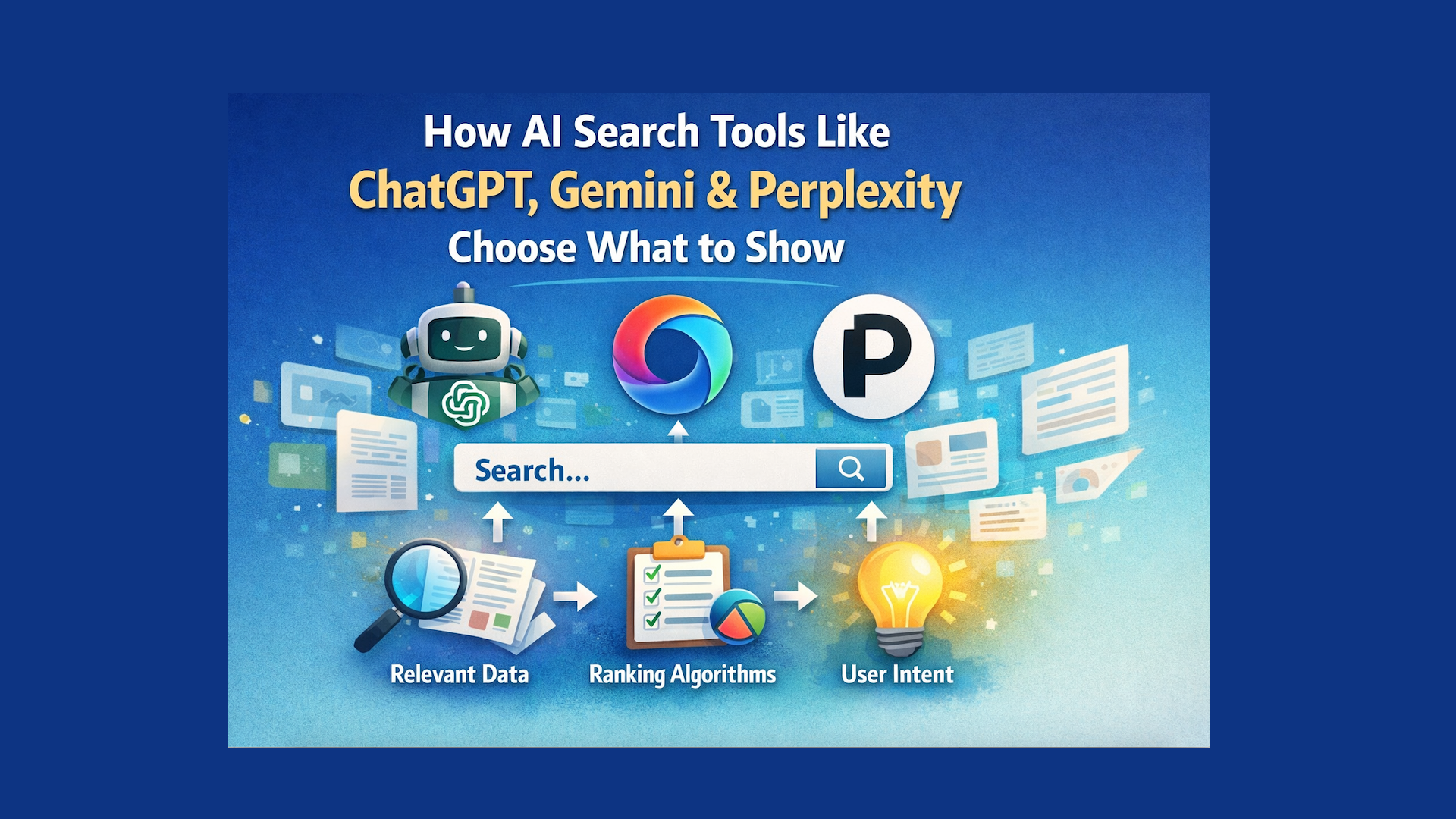
How AI Search Tools Like ChatGPT, Gemini & Perplexity Choose What to Show

AI search tools are changing how people find information online. Instead of showing ten blue links, they give direct answers, summaries, and clear explanations. This helps users save time, but it also changes how content is discovered and trusted.
In this guide, you’ll learn how AI search tools choose what to show, what factors matter most, and how content creators can write in a way that AI systems understand and reuse.
What Is AI Search and How Is It Different?
Traditional search engines mainly rank web pages by keywords and links. AI search goes further. It tries to understand your question, collect information from many trusted sources, and then create one helpful answer.
Popular AI tools include:
- ChatGPT (by OpenAI)
- Gemini (by Google)
- Perplexity (by Perplexity AI)
These tools do not just match words. They understand meaning, context, and intent.
The Core Technology Behind AI Search Tools
1. Large Language Models (LLMs)
At the heart of AI search are Large Language Models, also called LLMs. These models are trained on large amounts of text, such as books, articles, and websites.
LLMs help AI tools:
- Understand what a question means
- Find patterns in information
- Write clear, human-like answers
They do not “think” like humans. Instead, they predict the most useful words based on learned patterns.
2. Real-Time Web Data and Browsing
Training data gives AI a strong base, but it can be outdated. That is why many AI tools also use live web searches.
Real-time browsing helps with:
- News and current events
- Updated prices or product info
- Recently published research
This is why fresh and updated content is more likely to appear in AI answers.
3. Source Synthesis (Combining Many Sources)
AI search tools do not rely on one website. They:
- Scan many trusted pages
- Pull key facts from each
- Combine them into one clear answer
This process is called source synthesis. It helps reduce errors and gives a balanced view.
Websites with clear facts, strong structure, and expert writing are easier for AI to use.
How AI Search Tools Understand User Intent
User intent means why someone is asking a question. AI tools analyze intent before answering.
Common intent types:
- Informational – “How does AI search work?”
- Transactional – “Best AI SEO tools for businesses”
- Navigational – “Perplexity AI official website”
AI tools adjust answers based on intent. For example, a beginner question gets a simple explanation, while an advanced question gets more detail.
Key Factors That Decide What Content Gets Shown
1. Content Clarity and Structure
AI prefers content that is easy to scan and understand.
Best practices include:
- Clear headings (H2, H3)
- Short paragraphs
- Bullet points
- Direct answers near the top
FAQs and step-by-step sections work very well for AI extraction.
2. Credibility and Trust (E-E-A-T)
AI tools look for signals of Experience, Expertise, Authoritativeness, and Trustworthiness.
Strong trust signals include:
- Expert authors with real experience
- Accurate, fact-checked content
- Consistent brand presence
- Positive reviews or mentions
Content that sounds vague or exaggerated is less likely to be used.
3. Freshness and Updates
AI systems often prefer recently updated content.
Why freshness matters:
- Information stays accurate
- Trends and rules change
- Users trust up-to-date answers
Adding “Last updated” dates and refreshing older posts improves visibility.
4. Depth Without Fluff
AI search tools avoid thin or overly promotional pages.
They prefer content that:
- Explains topics fully
- Uses simple examples
- Avoids keyword stuffing
Helpful depth is more important than long word counts.
How Each AI Tool Chooses What to Show
How ChatGPT Selects Information
ChatGPT focuses on conversation and context. It:
- Builds answers step by step
- Remembers earlier questions
- Guides users with follow-ups
When browsing is enabled, it blends live data with learned knowledge.
How Gemini Works Inside Google Search
Gemini is closely tied to Google Search. It:
- Uses Google’s search index
- Applies ranking signals like authority and freshness
- Shows AI summaries alongside traditional results
This makes SEO fundamentals still very important.
How Perplexity Chooses Sources
Perplexity strongly focuses on citations. It:
- Shows direct source links
- Pulls from news, academic, and trusted sites
- Offers focused search modes
Clear and factual content increases the chance of being cited.
AI Search vs Traditional SEO
Traditional SEO:
- Focuses on ranking pages
- Relies heavily on keywords and backlinks
AI Search:
- Focuses on answering questions
- Values clarity, trust, and structure
- Often leads to zero-click answers
Modern SEO now means optimizing for answers, not just rankings.
How to Optimize Content for AI Search Tools
Here are simple steps anyone can follow:
- Answer the main question early
- Use clear headings and bullets
- Add FAQ sections
- Show author expertise
- Keep content updated
- Write in simple, natural language
These steps help both users and AI systems.
Frequently Asked Questions
How do AI search tools choose trusted websites?
They look at expertise, accuracy, reputation, and consistency across the web.
Do backlinks still matter for AI search?
Yes, but they matter less than clear, trustworthy information.
Can small websites appear in AI search results?
Yes. If content is clear, helpful, and well-structured, size does not matter.
How often should content be updated?
Review important pages every 6–12 months or when information changes.
Final Takeaway
AI search tools do not simply rank pages. They choose information, combine sources, and present answers. The best content is clear, trustworthy, updated, and written for real people.
If you focus on helpfulness first, AI visibility follows naturally.
Want your content to appear in AI search results like ChatGPT, Gemini, and Perplexity?
Start creating clear, expert-led, and well-structured content today — or work with an AI-SEO specialist to future-proof your strategy.
Get A Quote
Reach Out and Bring Your Visions to Life
Get A Quote
Reach Out and Bring Your Visions to Life