

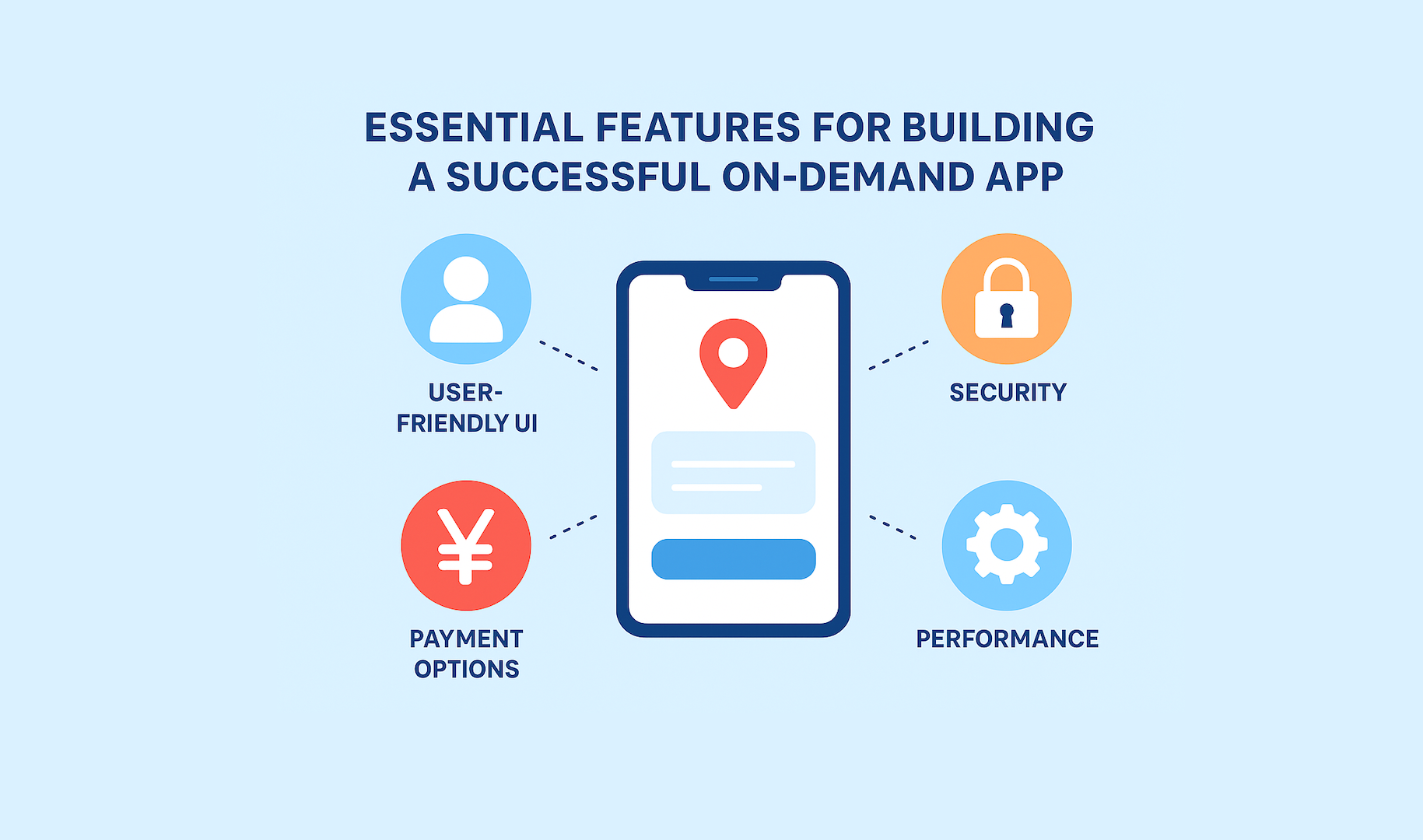
Essential Features for Building a Successful On-Demand App
- App Development
-

By Jaydeep
- September 15, 2025
The on-demand economy is booming. From booking a ride to ordering food, on-demand apps make life easier by connecting users with services instantly. Businesses that create user-friendly and reliable apps can reach more customers, build trust, and grow faster.
But success depends on more than just having an app—it’s about what features you include and how well you solve user problems.
In this blog, we’ll cover the must-have features for building a successful on-demand app, explain why they matter, and answer common questions businesses often ask before development.
What Is an On-Demand App?
An on-demand app is a mobile platform that connects customers with services or products in real time. Some popular examples include:
- Uber (transportation services)
- DoorDash (food delivery services)
- TaskRabbit (home services and repairs)
These apps succeed because they offer speed, trust, and convenience.
If you’re building your own app, you must design it with these values in mind while making sure it has the right functionality.
Why Are On-Demand Apps in High Demand?
People are shifting toward on-demand platforms because:
- Convenience: Book anytime, anywhere.
- Faster Services: Orders and rides arrive quickly.
- Personalization: Apps give suggestions based on past behavior.
- Trust: Ratings, reviews, and secure payments create confidence.
For businesses, this means a growing opportunity—but only if the app is reliable, easy to use, and secure.
Essential Features for Building a Successful On-Demand App
Here’s a complete checklist of features every on-demand app should have:
1. Simple Registration and Login
Users should sign up in seconds. Offer:
- Social media login (Google, Facebook, Apple ID)
- Mobile number with OTP verification
- Email registration
A fast login process reduces friction and improves user experience.
2. Powerful Search and Filters
Customers expect to find services easily. Add filters for:
- Price range
- Provider ratings
- Availability
- Location
This ensures users don’t waste time scrolling endlessly.
3. Real-Time Tracking
Tracking is one of the most important on-demand app features. For example:
- Food delivery customers want to see where their order is.
- Riders want to know how close their driver is.
- Service providers need directions to customer locations.
This builds transparency and trust.
4. Multiple Payment Gateways
Support all major payment options:
- Credit/debit cards
- UPI and digital wallets
- Net banking
- Cash on delivery (where applicable)
Add data encryption and PCI DSS compliance to ensure transactions are safe.
5. Ratings and Reviews
Trust is key in on-demand marketplaces. Users rely on reviews before booking.
- Customers should rate service providers.
- Providers can also review customers (optional).
- Businesses can use this feedback to improve services.
6. Push Notifications
Notifications keep users engaged by updating them about:
- Order status
- Promotions and discounts
- Service reminders
Be careful not to overdo it, or users may mute notifications.
7. In-App Chat and Support
Quick communication prevents confusion. Your app should offer:
- Customer-to-provider chat
- Chatbots for FAQs
- 24/7 support for escalations
This builds long-term loyalty.
8. Favorites and Wishlist
Let customers save frequently used services or providers. This makes repeat bookings easier and faster.
9. Secure Data Protection
Since users share sensitive details (location, contact info, payments), you must:
- Encrypt all user data
- Follow GDPR/local data laws
- Offer clear privacy settings
Strong security shows your app is trustworthy.
10. Admin Dashboard
A robust admin panel helps businesses manage everything in one place:
- Service provider onboarding
- Order management
- Payments tracking
- Data analytics
This makes it easier to scale operations as your user base grows.
Advanced Features to Stand Out
Once you’ve built the core features, consider adding:
- AI Recommendations: Suggest services based on past bookings.
- Loyalty Rewards: Discounts and points for repeat users.
- Multi-Language and Currency Options: Useful for global apps.
- Offline Mode: Let users access past orders or saved info without internet.
These advanced features can differentiate your app from competitors.
How to Build an On-Demand App (Step-by-Step)
If you’re wondering how to start, here’s a simple breakdown:
- Research your target audience – Who will use your app, and what problem will it solve?
- Define core features – Start with registration, search, payments, and tracking.
- Choose the right tech stack – Select scalable technologies for iOS and Android.
- Build an MVP (Minimum Viable Product) – Launch with essential features to test user response.
- Gather feedback and improve – Update the app based on customer needs.
- Add advanced features – Once you have a strong user base, expand with AI, loyalty programs, or multi-language support.
Frequently Asked Questions
Q1: How much does it cost to build an on-demand app?
The cost depends on features, complexity, and platform. A basic MVP can cost between $20,000–$50,000, while a full-featured app can go beyond $70,000.
Q2: How long does it take to develop an on-demand app?
It usually takes 3 to 6 months to build a functional app, depending on features and team size.
Q3: What platforms should I build for first—Android or iOS?
If your audience is global, build for both. If budget is limited, research which platform your target customers use more often.
Q4: How do on-demand apps make money?
Common models include:
- Commission on each transaction
- Subscription fees
- Service charges
- Advertising and promotions
Q5: How do I make my app stand out in the crowded market?
Focus on user experience, reliability, and trust. Add advanced features only after your core features work smoothly.
Final Thoughts
Building an on-demand app is more than just coding—it’s about delivering convenience, trust, and personalization to your users. By including features like real-time tracking, secure payments, in-app chat, and ratings, you set the foundation for success.
Advanced features such as AI-based recommendations or loyalty programs can take your app to the next level, but start with a solid base first.
If done right, your on-demand service app can compete with top players in the market.
At Codeclinic, we help businesses create secure, scalable, and user-friendly on-demand apps tailored to their needs.
Book a free discovery call today and start building your app with expert guidance.
Get A Quote
Reach Out and Bring Your Visions to Life
Get A Quote
Reach Out and Bring Your Visions to Life